
Brain injury | Success story

Longtime ICU nurse chooses Encompass Health for recovery after Aneurysm

For Casey Haney and her husband Tom, caring for others runs in the family. Casey is the chief nursing officer at Encompass Health Rehabilitation Hospital of Dothan. Tom was an ICU nurse for 30 years and, more recently, worked as a hospital educator teaching nurses CPR and advanced cardiovascular life support (ACLS). Tom and Casey have two children, a son in high school and a grown daughter who requires additional care due to intellectual disabilities. Tom is also a girls high school volleyball coach and enjoys playing the sport himself to stay in shape. When Tom suffered a medical emergency, his and his family's life changed drastically.

Receiving the diagnosis

After their son's basketball game, Tom wasn't feeling well and started to exhibit stroke-like symptoms including confusion and slurred speech. Knowing the importance of early intervention, the couple quickly went to the emergency room. Tom was diagnosed with an aortic aneurysm — a bulge that occurs in the wall of the major blood vessel (aorta) that carries blood from the heart to the body. "If it's not discovered it will rupture and honestly could cause immediate death," Casey said. Due to the severity of Tom's aneurysm, he had to travel more than two hours from his home for surgery.

Choosing the right rehabilitation

Due to post-operation complications Tom was in the hospital for longer than expected. He was intubated for an extended period of time, leading to swallowing challenges. His mobility was diminished, and everyday tasks like brushing teeth and getting dressed on his own were difficult. "One of his biggest goals was to get back to coaching and to be as independent as possible because he is the primary caregiver of our child. He does all the things for our family," Casey said. When it was time to leave the acute care hospital and continue recovery in a different care setting, Casey and Tom chose Encompass Health Dothan. "I know what we can do here. I knew who was going to be caring for him, and that was such peace and comfort," Casey said.

Up and at 'em

Eager to get back to his family and coaching, Tom embraced inpatient rehabilitation and followed his customized therapy plan to a T. He could only lift up to eights pounds at a time and lacked the stamina needed to walk for more than a couple of minutes at a time. He also required a modified diet for his swallowing problems. But he and his care team persevered. "The staff really encouraged me and wouldn't take no for an answer," Tom said.

Occupational therapy propelled him toward achieving his first goal in recovery — independently getting himself ready each morning for his physical therapy sessions. "For him to be able to do his activities of daily living independently — like brush his teeth, get in the shower and get dressed — was one of his big goals because he wanted to get his day started as quickly as possible," Casey said.

In a week's time, Tom progressed from requiring assistance to stand and walk, to walking with a walker to climbing up and down stairs a few steps at a time without a walker. He also improved his swallowing capabilities and was able to transition to a regular diet during his 10-day stay at Encompass Health. Casey, who's seen many recoveries in her time at Encompass Health Dothan, was blown away by his progress. 
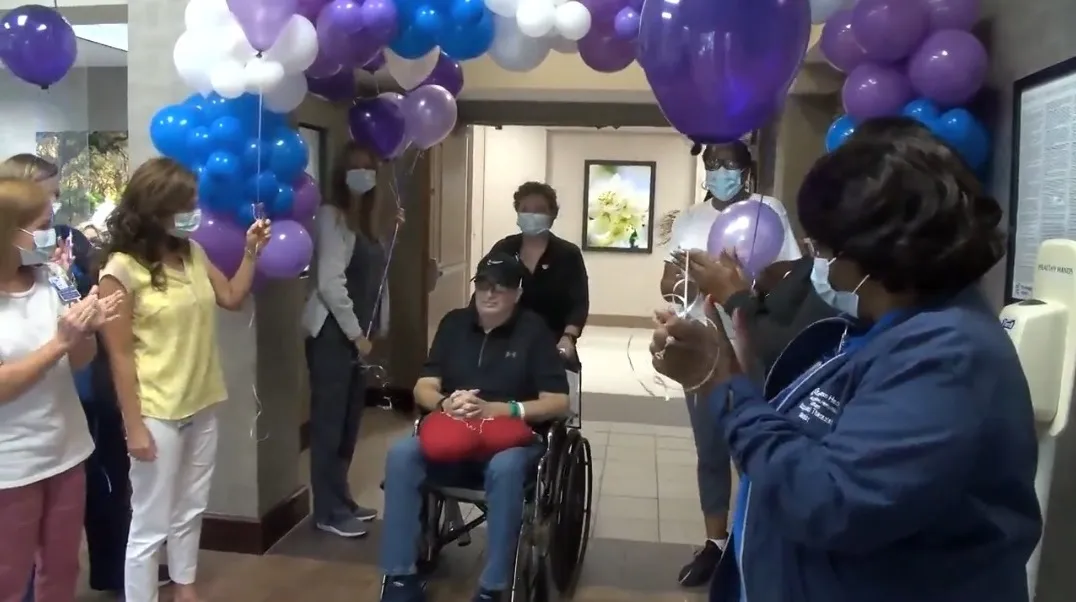
Tom Haney's care team celebrates his departure at Encompass Health Rehabilitation Hospital of Dothan.

"What he was able to accomplish in just 10 days was huge. In such a short time period it was just tremendous compared to the therapy he got at the (acute care) hospital before coming here."
Casey Haney

Inpatient rehabilitation for the win

Tom shared the joy he felt when he got to enjoy a seemingly ordinary occurrence shortly after returning home. "We went out for dinner for the first time since my hospitalization, and I was able to walk in and out of the restaurant and just be able to sit with my family and enjoy dinner," he said.

He was also cleared to start coaching volleyball again, and hopefully playing again soon too. "I love the game. I picked it up early in my adult life and have played for 25-30 years. (As a coach) being with the girls and watching them grow and learn to play well is just such a good experience."

What is dysphagia? 

Like aphasia, it can be caused by neurological conditions such as brain injuries and stroke, but it also can stem from muscle disorders, certain cancers and blockages/strictures in the throat. 

Depending on the cause, dysphagia can be temporary or long-term. 

Conditions commonly associated with dysphagia include: 

  • Parkinson’s disease and multiple sclerosis
  • Neck and throat cancers
  • Late-stage Alzheimer’s disease and other dementias
  • Cervical neck surgeries 

Stages of dysphagia 

There are three phases of swallowing that are impacted with dysphagia: 

  • Oral: This is the process of chewing food and mixing it with saliva to form a bolus in order for it to be moved from the front of the mouth to the back of the mouth. A person with dysphagia in this phase could have trouble breaking down the food enough to properly move it to the back of the mouth to trigger the swallowing reflex. This stage is also where tongue weakness or decreased sensation may impact the ability to clear food from the sides of the mouth causing it to pocket in the cheeks.
  • Pharyngeal: This is where the swallowing reflex begins, and pharyngeal muscles push food down the throat to the esophagus. The epiglottis (a cartilage) inverts to protect the airway and sends the bolus towards the esophagus. This is when the upper esophageal sphincter opens to allow food to travel into the esophagus. A person with dysphagia in this phase might feel like the food is “entering the wrong pipe,” Delashaw said, because the muscles in the pharynx and/or larynx are not operating properly to prevent food or liquids from entering the airway.
  • Esophageal: This is when the bolus is taken from the upper esophageal sphincter that has opened, allowing it to enter the esophagus. Peristalsis (muscle contractions) carries the bolus from the upper esophagus towards the stomach. In this phase, a person with dysphagia may feel like food is stuck in their throat or chest. 

Symptoms of dysphagia 

Dysphagia symptoms could include: 

  • Coughing or choking during or shortly after eating or drinking
  • Heartburn or indigestion
  • Feeling that food is stuck in the throat or chest
  • Painful swallowing
  • Regurgitation
  • Food sitting in the mouth or being pocketed in the cheeks
  • Unexplained weight loss
  • Reduced desire to eat 

Diagnosing dysphagia 

Dysphagia is diagnosed by a healthcare provider. Speech-language pathologists diagnose dysphagia with a comprehensive oral exam and swallowing examination, which should include swallowing tests such as a FEES or MBS exam. 

  • FEES: FEES stands for fiberoptic endoscopic evaluation of swallowing. This is an exam where a speech-language pathologist inserts a small thin scope with a camera through the nose and allows visualization of the throat, larynx and vocal cords to assess swallow function as you eat and drink certain foods.
  • MBS: During a modified barium swallow study, a speech-language pathologist will give you food and liquids covered in a small amount of barium. As you swallow, X-rays are performed to view your swallow in real-time. 

Treatment of dysphagia 

After a dysphagia diagnosis, a speech-language pathologist can help determine what consistency of food and liquids is safest to eliminate risk of choking or aspiration. They can also provide therapy and exercises to help strengthen the muscles used during the different stages of swallowing.  

Treatment should always involve a discussion with the individual to determine their wishes regarding oral intake and development of dysphagia treatment.  

“If difficulty is noted in the oral phase, we can design an exercise program to target movement for the muscles used when breaking down the food,” Delashaw said. “Say you had a stroke that impacted lip muscles, and you can’t hold food in your mouth. We’re going to work on increasing the control and strength of the lip muscles, so you do not lose liquids or foods out of the mouth.” 

In addition to exercises, Delashaw said neuromuscular electrical stimulation could also be used to increase muscle awareness in the different stages of dysphagia. 

In the esophageal stage, your speech-language pathologist could suggest obtaining a referral from your primary care doctor to a gastroenterologist for further evaluation. 

Recovery from dysphagia 

Depending on the diagnosis and related conditions, dysphagia could improve over time. If swallowing difficulty is related to a neurological condition, inpatient rehabilitation could help develop adaptive techniques and diet plans to meet your needs and quality of life standards.

The multidisciplinary approach in this setting also allows for other symptoms related to your condition to be addressed through intensive therapy. In addition to working with a speech-language pathologist, your therapy team would also include a physical therapist and occupational therapist to address mobility and strength as well as activities of daily living and quality of life.

Health resources

Get more healthcare resources and healthy aging tips from our rehabilitation experts.
Explore our health resources

Find an Encompass Health location near you

Find a location