Aphasia and dysphasia are terms for the same disorder, but they are not the same as dysphagia, a swallowing disorder. Understand the differences and how these conditions can be treated by a speech-language pathologist.
Clincally reviewed by: Lori Delashaw, SLP
Aphasia and dysphasia are two different terms used to describe the same language disorder that can develop after a stroke, traumatic brain injury or other neurological condition.
The two terms are not to be confused with dysphagia, a swallowing disorder.
Because of the confusion, most medical professions discontinued the use of the term dysphasia, and simply refer to the language disorder as aphasia, said Lori Delashaw, a speech-language pathologist at Encompass Health Rehabilitation Hospital of Pensacola in Florida.
What is aphasia?
Aphasia is a communication disorder that can impact language comprehension and/or the ability to use spoken language. It can also impact one’s ability to read or write, but it does not impact intelligence.
“It’s not a mental illness or an intellectual impairment even though it can come across as one to an unfamiliar listener,” Delashaw said. “I’ve heard patients make comments that they feel stupid, or they can’t do that anymore. There’s a lot of frustration and a feeling of loss.”
Aphasia causes
Aphasia occurs when the area of the brain that controls language expression and comprehension of language is damaged.
Common causes include:
The most common cause of aphasia is stroke. Brain tumors, head injuries, infections and inflammation and progressive neurological diseases can also lead to aphasia.
Those with aphasia may have difficulty understanding what is said to them or have trouble expressing their thoughts and needs, which often leads to frustration and agitation.
Types of aphasia
There are many different types of aphasia. Diagnosis is usually determined by whether the aphasia is fluent or non-fluent.
- Fluent aphasia: Speech and sentence structure flow normally but may lack meaning at times. Fluent aphasia can be categorized as a Wernicke's aphasia (receptive aphasia), conduction aphasia, transcortical sensory aphasia or anomic aphasia.
- Non-fluent: Speech is halting and choppy, and sound production may be impaired.
Some of the more common types of non-fluent aphasia include Broca's aphasia, also known as expressive aphasia, or transcortical motor aphasia.
Symptoms of aphasia
Aphasia symptoms are determined by the location and severity of the brain injury. All components of language can be impacted with aphasia including speech and expression of language, comprehension of language, reading and writing. The ability to use and recognize letters and numbers can also be affected.
Symptoms include:
- Difficulty finding the right words.
- Speaking slowly in halted, short basic words or phrases.
- Making up words (nonsense words). For example, “going outside” becomes “jelling flopity.”
- Telegraphic speech — speaking in simple phrases or omitting small words (e.g., “I hungry”).
- Mixing up words or word order.
- Substituting words or sounds within words. “Bookcase” could become “cookcake” or “butter” becomes “bubster.”
- Inability to answer simple questions due to confusion on what is being asked.
- Unable to understand other people's speech, especially in groups, or with background noise. It may sound like someone is speaking a foreign language.
- Difficulty comprehending other people’s conversations.
- Problems with writing and spelling words and phrases.
- Unable to recite or repeat words and sentences.
Diagnosing aphasia
Neurological assessment, brain imaging and a comprehensive language assessment by a speech-language pathologist are needed to diagnose aphasia.
- Brain imaging tests may be ordered to determine the location and extent of brain injury.
- Sensory and nerve function studies are used to rule out other problems that could mimic aphasia.
- Comprehensive communication examination by a speech-language pathologist to determine the individual’s ability to speak, understand, read, write, converse and express ideas.
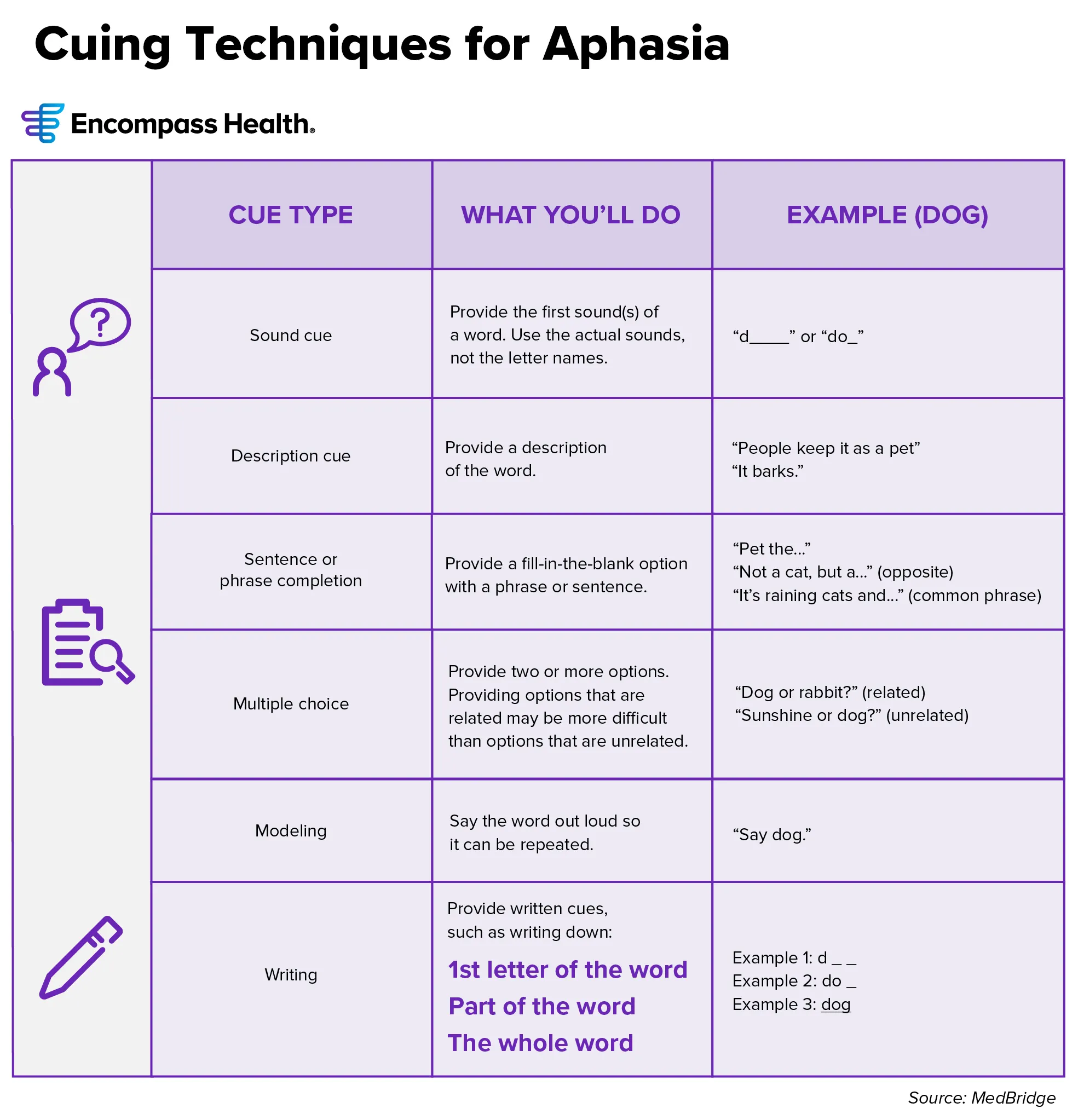
Treatment of aphasia
Outcomes are best when treatment is initiated as soon as possible. Delashaw said it should start with simple solutions that allow the individual to communicate on the best level of their stage of recovery. Initially, that could require a picture-based communication board to establish a means to communicate basic level needs and wants.
"They can't figure out how to communicate," she said. "Think about having to go through your day not being able to talk at all. It's impossible, but that's what they're going through. Sometimes you have to start with basic gestures and picture-based communication boards. It's limited, but a first step to establishing a means of communication for a patient, even if it's just a thumbs up or a thumbs down. I'll also use music and singing to bring out words."
Treatment for aphasia is highly personalized since needs vary from person-to-person but usually includes:
- Exercises aimed at regaining lost communication skills
- Boosting remaining communication skills
- Learning new ways of communication
Tips for communicating with someone with aphasia
Those with aphasia often feel frustrated and discouraged. Difficulty communicating can lead to feelings of isolation and loneliness. The National Aphasia Association lists the following tips for communicating with someone with aphasia:
- Get their attention. Make sure you have the person’s attention before beginning communication.
- Reduce distractions. Minimize background noise such as TV or music.
- Speak at a normal volume. Don’t shout unless requested.
- Keep communication simple. Use clear, adult language — don’t speak down to them or use baby-talk.
- Speak slowly and clearly. Allow time to process.
- Be patient. Allow time for the person to speak Don’t interrupt or finish sentences.
- Use drawings, gestures, writing and facial expressions with verbal communication to increase comprehension.
- Ask yes and no questions to confirm understanding.
- Praise all speech attempts and downplay errors.
- Engage normally and include those with aphasia in family and group conversations and decisions.
- Encourage independence.
- Avoid being overly protective.
Recovery from aphasia
Multiple factors impact aphasia recovery success, including:
- Brain damage severity
- Area of the brain that was damaged
- Age and overall health
- Other health or communication problems
- Motivation
Most individuals recovering from stroke see an improvement within the first six months to a year following a stroke as the brain heals. After this time, improvement slows but is still possible. A study from the Journal of Speech, Language, and Hearing Research revealed 95% of individuals with mild aphasia improved substantially and steadily in the first two weeks after a stroke.
Individualized, specialized rehabilitative care initiated as soon as possible offers the best chance for recovery.
Treatment should be started immediately in the acute care setting and outpatient settings.

Post-Stroke Dysphagia | Encompass Health
What is dysphagia?
Like aphasia, it can be caused by neurological conditions such as brain injuries and stroke, but it also can stem from muscle disorders, certain cancers and blockages/strictures in the throat.
Depending on the cause, dysphagia can be temporary or long-term.
Conditions commonly associated with dysphagia include:
- Parkinson’s disease and multiple sclerosis
- Neck and throat cancers
- Late-stage Alzheimer’s disease and other dementias
- Cervical neck surgeries
Stages of dysphagia
There are three phases of swallowing that are impacted with dysphagia:
- Oral: This is the process of chewing food and mixing it with saliva to form a bolus in order for it to be moved from the front of the mouth to the back of the mouth. A person with dysphagia in this phase could have trouble breaking down the food enough to properly move it to the back of the mouth to trigger the swallowing reflex. This stage is also where tongue weakness or decreased sensation may impact the ability to clear food from the sides of the mouth causing it to pocket in the cheeks.
- Pharyngeal: This is where the swallowing reflex begins, and pharyngeal muscles push food down the throat to the esophagus. The epiglottis (a cartilage) inverts to protect the airway and sends the bolus towards the esophagus. This is when the upper esophageal sphincter opens to allow food to travel into the esophagus. A person with dysphagia in this phase might feel like the food is “entering the wrong pipe,” Delashaw said, because the muscles in the pharynx and/or larynx are not operating properly to prevent food or liquids from entering the airway.
- Esophageal: This is when the bolus is taken from the upper esophageal sphincter that has opened, allowing it to enter the esophagus. Peristalsis (muscle contractions) carries the bolus from the upper esophagus towards the stomach. In this phase, a person with dysphagia may feel like food is stuck in their throat or chest.
Symptoms of dysphagia
Dysphagia symptoms could include:
- Coughing or choking during or shortly after eating or drinking
- Heartburn or indigestion
- Feeling that food is stuck in the throat or chest
- Painful swallowing
- Regurgitation
- Food sitting in the mouth or being pocketed in the cheeks
- Unexplained weight loss
- Reduced desire to eat
Diagnosing dysphagia
Dysphagia is diagnosed by a healthcare provider. Speech-language pathologists diagnose dysphagia with a comprehensive oral exam and swallowing examination, which should include swallowing tests such as a FEES or MBS exam.
- FEES: FEES stands for fiberoptic endoscopic evaluation of swallowing. This is an exam where a speech-language pathologist inserts a small thin scope with a camera through the nose and allows visualization of the throat, larynx and vocal cords to assess swallow function as you eat and drink certain foods.
- MBS: During a modified barium swallow study, a speech-language pathologist will give you food and liquids covered in a small amount of barium. As you swallow, X-rays are performed to view your swallow in real-time.
Treatment of dysphagia
After a dysphagia diagnosis, a speech-language pathologist can help determine what consistency of food and liquids is safest to eliminate risk of choking or aspiration. They can also provide therapy and exercises to help strengthen the muscles used during the different stages of swallowing.
Treatment should always involve a discussion with the individual to determine their wishes regarding oral intake and development of dysphagia treatment.
“If difficulty is noted in the oral phase, we can design an exercise program to target movement for the muscles used when breaking down the food,” Delashaw said. “Say you had a stroke that impacted lip muscles, and you can’t hold food in your mouth. We’re going to work on increasing the control and strength of the lip muscles, so you do not lose liquids or foods out of the mouth.”
In addition to exercises, Delashaw said neuromuscular electrical stimulation could also be used to increase muscle awareness in the different stages of dysphagia.
In the esophageal stage, your speech-language pathologist could suggest obtaining a referral from your primary care doctor to a gastroenterologist for further evaluation.
Recovery from dysphagia
Depending on the diagnosis and related conditions, dysphagia could improve over time. If swallowing difficulty is related to a neurological condition, inpatient rehabilitation could help develop adaptive techniques and diet plans to meet your needs and quality of life standards.
The multidisciplinary approach in this setting also allows for other symptoms related to your condition to be addressed through intensive therapy. In addition to working with a speech-language pathologist, your therapy team would also include a physical therapist and occupational therapist to address mobility and strength as well as activities of daily living and quality of life.