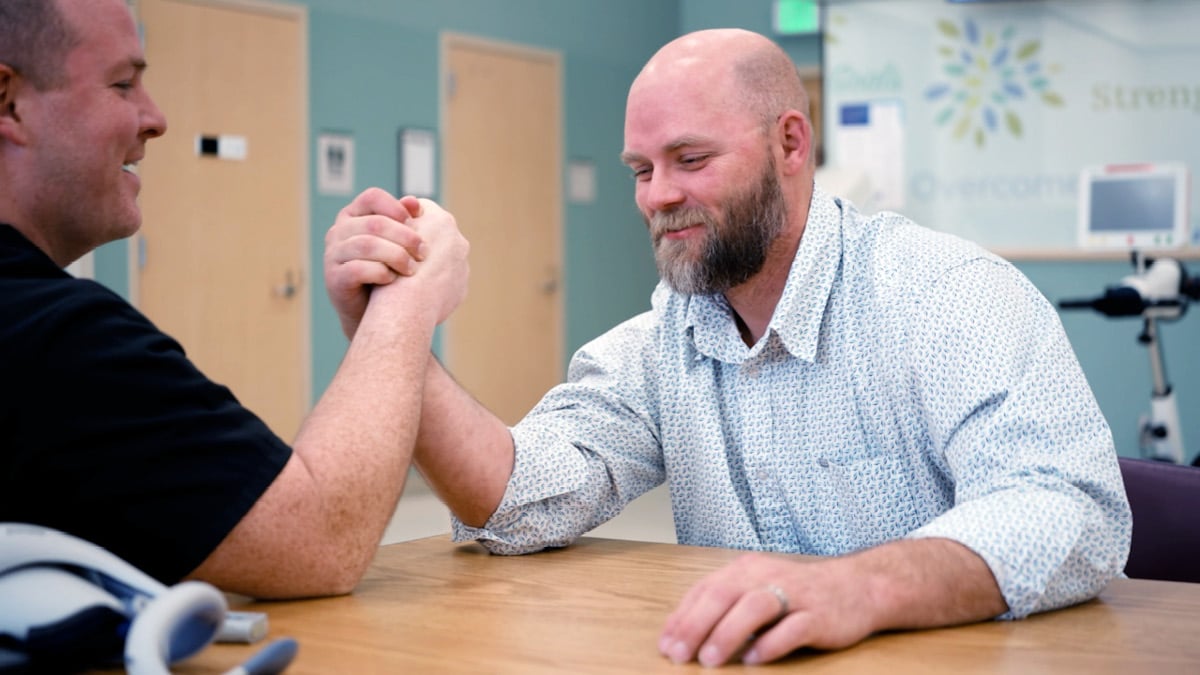
Bryan's story: Recovering from stroke at 40
Bryan Griffith was living an active life at 40, when a stroke suddenly stopped the father of four in his tracks. He couldn't walk or perform basic tasks on his own. Determined to return to his family, he entered inpatient rehabilitation and was able to reclaim his life and reach his goals.
At 40, Bryan Griffith was living an active life. He was a husband and father of four, active in youth sports and served on the town council, in addition to working a full-time job as a military mechanic.
He knew he could eat a little healthier and better manage his type 1 diabetes, but otherwise, he wasn’t concerned about his health.
“I was living a very active life,” he recalled. “I was all involved and completely independent. I was constantly going.”
That was until a stroke stopped him in his tracks.
Sudden symptoms
Bryan was at work at the Army Depot in Anniston, Alabama when he suddenly began feeling ill. He arrived at 6 a.m. that morning, and by 6:15, he could hardly stand.
“I started feeling really bad,” he said. “I was just going to sit down for a few minutes. I put my head down and could barely get up. My jaw hurt, and then my co-workers looked at me and said my mouth was drooping.”
Though the signs of stroke were there, Bryan didn’t immediately understand the seriousness of his condition. He headed to the on-site clinic to get checked out.
He was transported to a nearby hospital for observation.
He called his wife, Misty, to alert her and tell her about his symptoms. As a registered nurse, she immediately knew he was having a stroke.
“It turned out to be more than an observation,” Bryan said.
Stabilizing his condition and determining next steps
At the hospital, Bryan was administered a clot-buster medication, a time-sensitive treatment for stroke that helps break up blood clots in the brain.
Once his condition stabilized, it was clear he would need additional care before he was able to return home to his wife and children.
“I pushed for inpatient rehabilitation because I’m a nurse, and I knew what he would need,” Misty said. “He was not going to be able to get that with every day home health. He needed very structured every day therapy, and therapists who were going to push him.”
After research and talking with friends and family, Misty and Bryan determined that Encompass Health Rehabilitation Hospital of Gadsden was where he needed to go to continue his recovery.
There, he would receive the intensive therapy Misty knew he needed, as well as 24/7 nursing care and frequent physician visits.
Setting and exceeding his recovery goals
Bryan was admitted to Encompass Health Gadsden on a Saturday. First thing the next morning, he was being evaluated by his care team and setting goals for his rehabilitation and recovery.
“When I first got to Encompass Health, I couldn’t do anything,” Bryan recalled. “I couldn’t even close my right eye.”
Bryan’s stroke impacted his right side. He was extremely weak and could only manage taking a few steps with assistance.
His goals were simple, but his care team warned him it would take hard work and dedication to accomplish them. He wanted to return home to his family and eventually his active life.
“I saw his age, and I saw all the things he had going on,” said Michelle Angel, his physical therapist. “It just made me immediately want to tap in and figure out what we could do to help him. I said, ‘This is going to be the hardest journey you’ve ever had, but if you tap in with me, I’m going to tap in with you.’”
Bryan was in rehabilitation a little over two weeks, and during that time he worked hard both during his therapy sessions and when he returned to his room.
“He was highly motivated,” said Paul Sewell, his occupational therapist. “He’d keep working when he got back to his room. He was very motivated to get back to his family.”
In physical therapy, he worked on activities to build his strength and endurance, learning to walk again and safely make transfers. In occupational therapy, he worked on activities of daily living and strengthening his right hand so he could perform tasks such as signing his name and buttoning his shirt.
When Bryan was ready for discharge, he surprised his family and many of his Encompass Health team by pushing his walker aside and walking on his own to ring the hospital’s independence bell.
Continuing his recovery at home
Bryan was able to return home to his family, just in time for Christmas. He was walking with the support of a walker or cane and said he continues to improve and work toward getting back to his pre-stroke self.
“Every day, I’m getting a little bit better,” he said. “I got a little quad walker I’m using, and I’ve been walking around the house on my own. I’ve improved tremendously.”
He’s also attending his children’s games as often as he can.
Misty said they couldn’t have prepared for a stroke at age 40, but they’re glad they found the rehabilitation they needed to get her husband home.
“If we had to go back and make any other decisions, I wouldn’t change anything,” Misty said. “I would have chosen Encompass Health.”
Health resources
Get more healthcare resources and healthy aging tips from our rehabilitation experts.
Related Articles
Find an Encompass Health location near you