Recognizing the signs of stroke in women can save lives. While many symptoms are the same for men and women, women may also experience less obvious warning signs that are easier to miss. Acting quickly can lead to faster treatment and better recovery.
Every year, more than 795,000 people in the United States have a stroke — about one every 40 seconds — according to the Centers for Disease Control and Prevention (CDC). One in five women has a stroke during her lifetime, with 55,000 more women having strokes than men each year, according to the American Stroke Association (ASA).
Many causes of stroke are preventable and treatable. Recognizing the signs of stroke in women can help lead to quicker treatment, which greatly improves the odds of recovery.
Stroke risk in women
Age is one unpreventable risk factor for stroke. Because women tend to live longer than men, they have a higher lifetime risk of experiencing a stroke, said Dr. Syed Kazmi, stroke program director at Encompass Health Rehabilitation Hospital of Round Rock.
"The incidence of stroke is slightly higher in males, but the lifelong risk of having a stroke is higher in females," Kazmi said. "After age 75, the incidence of stroke becomes much higher in males and females both, but there are more females living in that age group."
Risk factors for stroke
Many stroke risk factors are the same for men and women and can often be managed. These include high blood pressure, high cholesterol, diabetes, obesity, excessive alcohol consumption and smoking.
Certain factors can increase a woman's risk of stroke, including pregnancy and the use of hormonal contraceptives.
"Whenever females — or males — are using additional hormones, that becomes a risk factor," Kazmi said.
Although stroke during pregnancy is uncommon, it can occur due to high blood pressure, preeclampsia and gestational diabetes. Pregnancy also increases the risk of blood clots.
According to the American Heart Association (AHA), pregnancy complications, as well as preterm delivery, small-for-gestational-age delivery, pregnancy loss and placental abruption may increase a woman's risk for cardiovascular disease later in life.
Signs of stroke in women
The major signs of stroke in women are similar to those of men. Remembering the acronym FAST can help you recognize a stroke and get emergency care quickly.
- F — Facial drooping
- A — Arm weakness
- S — Speech becomes altered or slurred
- T — Time to call 911
A common variation of the acronym is BE FAST, which also includes:
- B Balance problems
- E — Eye or vision changes
Women may also experience more subtle stroke symptoms, including:
- Sudden weakness or fatigue
- Disorientation, confusion or memory problems
- Nausea or vomiting
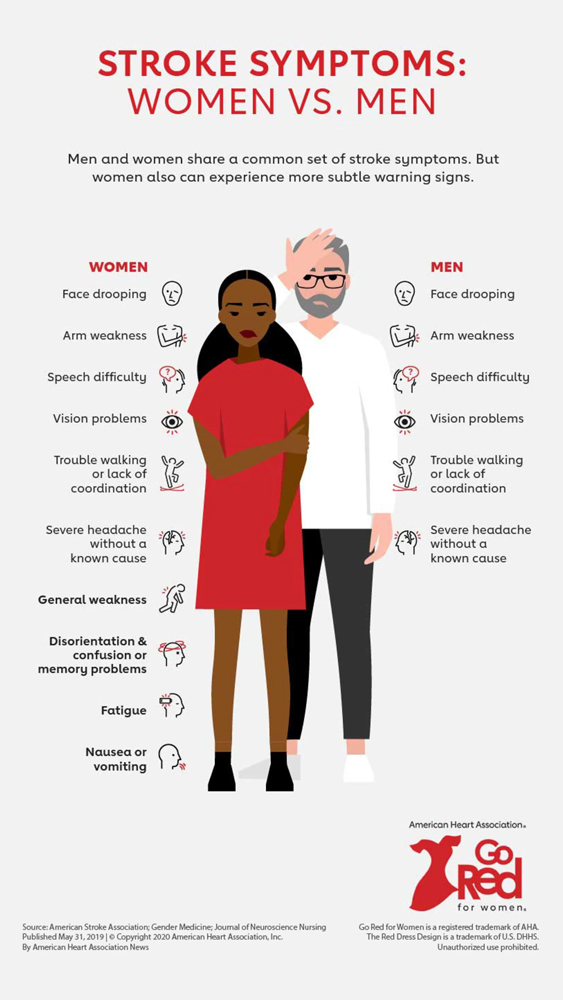
The AHA provides a visual comparison of stroke symptoms in women and men.
If you notice any of these signs in yourself or someone else, call 911 immediately. Stroke is a medical emergency. Early treatment can increase care options and improve recovery.
"Each and every stroke is different, but there are some generalizations we can make," Kazmi said. "As soon as you recognize these symptoms, you need to call 911 immediately. If the brain sustains significant damage, it is impossible to completely revert it. However, if interventions are provided early, you may be able to prevent major damage to the brain."
Rehabilitation after a stroke
If you or a loved one has had a stroke, inpatient rehabilitation can help maximize your recovery.
According to the adult stroke rehabilitation guidelines released by the AHA, stroke patients should be treated at an inpatient rehabilitation hospital whenever possible. "While at an inpatient rehabilitation hospital, a patient participates in at least three hours of rehabilitation a day from physical therapists, occupational therapists, and speech therapists. Nurses are continuously available and doctors typically visit daily. An in-patient rehabilitation hospital may be a freestanding facility or a separate unit of a hospital."
Find an Encompass Health hospital near you to learn more about how inpatient rehabilitation can help with stroke rehabilitation.